
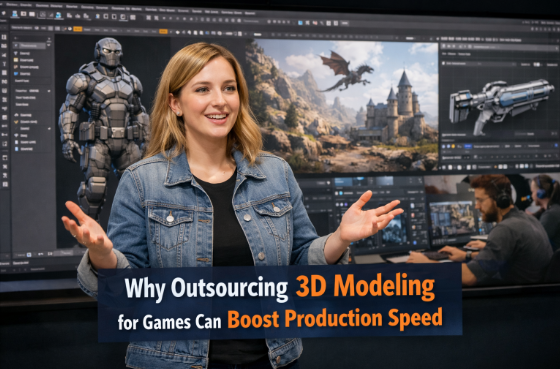
The timelines for game development are getting narrower while keeping higher player expectations to offer more enhanced graphics, much larger worlds, and smoother performance. No more time is to be added to the release schedules to accommodate these new additions.
Here is where outsourcing of 3D modeling for games comes in, and it is more than a strategic advantage, although there is also that argument about the cost. Production speed and removal of internal bottlenecks keep production going at full throttle without sacrificing quality. By outsourcing to specialized teams, studios can enjoy all of these.
Access to Ready-Made Expertise Without Ramp-Up Time
Building up an in-house art team requires time and is not a fast process. This all delays the early production stages concerning hiring, onboarding, and getting the artists into your style and pipeline.
When outsourcing to artists for 3D game models, one gains access to a plethora of industry standards, workflows, and tools, so much so that the teams would start delivering valuable assets almost immediately, drastically reducing production cycles, and keeping everything on schedule.
Parallel Production That Eliminates Bottlenecks
Outsourcing offers to cut the workforce by doing things simultaneously. The in-house teams would be concentrating on levels, gameplay mechanics, or optimizations while characters, props, and environment assets are being worked out by the outsourced team.
All this builds up and fast-tracks development by a lot. Instead of waiting for internal bandwidth to be freed up for the asset creation to move forward, the creation continues in the background. For large projects or content-heavy projects, outsourcing 3D modeling for games prevents the choking that can occur within the asset pipeline.
Faster Scaling During Peak Production Phases
Though the amount of production in video games does not remain constant, periods are marked in which the demand for assets dramatically increases. The primary examples of this are vertical slices, content lock, or pre-launch polish.
Short-term internal scaling of the workforce for short-lived needs is costly and inefficient. The result is outsourcing, which allows scaling up or down very quickly depending on the workload. By increasing external scope, demand for assets can be met.
When it slows, you scale back without layoffs or long-term overheads. This flexibility directly improves production speed and planning confidence.
Established Pipelines and Proven Workflows
Being a project specialized in outsourcing teams means working on multiple projects across genres on multiple platforms. As a point of fact, they maintain refined pipelines meant purely for efficiency.
Built-in are file structure, naming conventions, version control, and engine compatibility. When outsourcing 3D modeling for games, it automatically means getting these systems mature without the need for creation or optimization from internal systems. Assets arrive cleaner, more consistent, and integrate very well, thus saving time during rework and revisions.
Reduced Iteration Time Through Focused Roles
In-house teams usually wear multiple hats, from tweaking concepts to fixing technical problems. On the contrary, the outsourced teams purely focus on asset delivery. This clarity leads to speedier iteration cycles.
Feedback is applied faster, revisions are more targeted, and turnaround times stay predictable. With the scope clearly defined, artists are able to refine assets without distraction. This keeps production on track rather than looping endlessly over minor adjustments.
Better Use of Internal Creative Resources
Outsourcing does not substitute your core team by itself, but empowers them. While internal artists deal with high-impact assets, asset-heavy tasks are handled externally. This labor division has yielded an increase in overall productivity. Internal teams guide the vision while outsourced teams execute at scale.
The combination, therefore, ensures speedier output without the dilution of creativity, especially when backed by credible 3D modeling services that closely align with the art style and technical specifications.
Lower Risk of Production Delays
Deadlines get missed when production activities on an asset get delayed. And this is where outsourcing comes in,- distributing a certain amount of work from one team to many more.
When one area slows down, others may keep moving. Some studios use outsourcing as a buffer for unforeseen delays, so that content creation does not stall any development elsewhere. Outsourcing of game 3D modeling builds greater resilience into production pipelines and avoids last-minute crunches for studios.
Conclusion
Outsourcing 3D modeling for games is now more than just cutting off that extra cost. It can mean quicker turnaround, more flexibility, and a lot smarter approach to resource management.
Immediate access to skilled artists, parallel workflows, and scalable production will enable studios to race ahead without lowering their quality standards.
Outsourcing, if done efficiently, becomes a vehicle of growth; it guides development properly, conserves realistic timelines, and keeps the creative teams on focus about their primary tasks.